

Beyond AI Chatbot: Our AI-Confident Framework for Building Scalable AI Systems
By 8am Business
Over the past 2 years, nearly every business leader has tried a chatbot.
You’ve typed a prompt into ChatGPT or Gemini, received a "good enough" answer.
And it is! But "good enough" doesn’t scale.
While chatbots are great for exploration, ideation, and one-off tasks, they are not designed to run departments, manage data pipelines, or produce hundreds of corporate-grade reports.
If you want AI to deliver real business outcomes, you don’t need better prompts or better models.
You need AI systems.
The Real Problem with Chatbots and Agentic AI
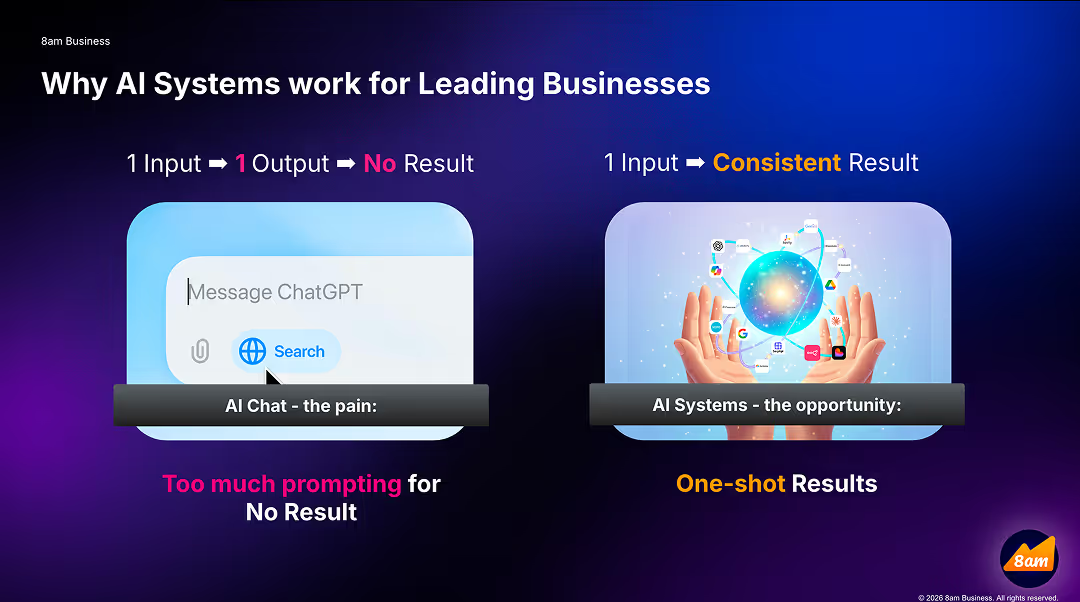
Most organisations today are still operating in manual AI mode. A human writes a prompt, evaluates the response, tweaks it, and repeats the process.
This works for individuals but is an immense cost at organisation scale.
Even agentic AI — while promising — introduces new challenges. Autonomous agents can plan and execute tasks across tools, but without strong orchestration, they can behave unpredictably, hallucinate decisions, or violate governance rules. This is why many early agent projects stall or get quietly rolled back.
Ask yourself: if you could hire Einstein to take over your accounting department with no supervision, would you do it?
The issue isn’t intelligence. It’s design.
Chat-based AI is reactive. Agentic AI is probabilistic. Businesses, however, require predictability, accountability, and repeatability. That’s where AI systems win.
So, what really is an AI System?
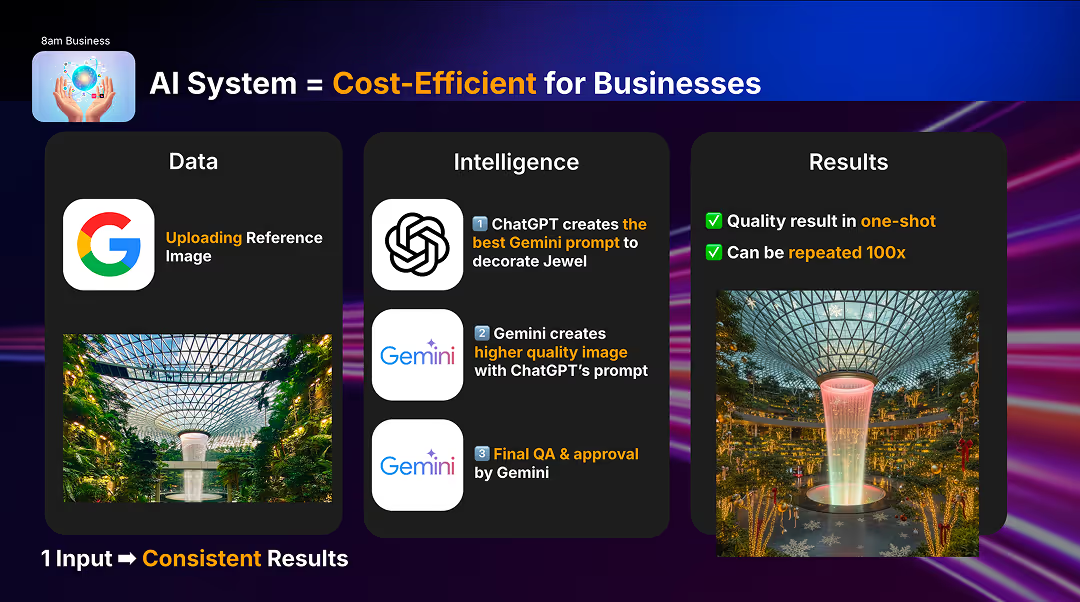
An AI system is a human-designed set up that intentionally uses AI to generate consistent, predictable results.
For example for a Marketing Agency using AI to produce creative assets:
- AI chat will give you 5 random apple images across 5 prompts.
- Agentic AI might end up procuring 50 apples (unpredictable).
- And an AI system will produce 500 apple images that are consistent with the brand guideline of each of your client.
The AI-Confident Framework: How Scalable AI Is Actually Built
AI-Confidence doesn’t come from trusting the model more. It comes from designing the AI system that outputs consistent results that you can take ownership of.
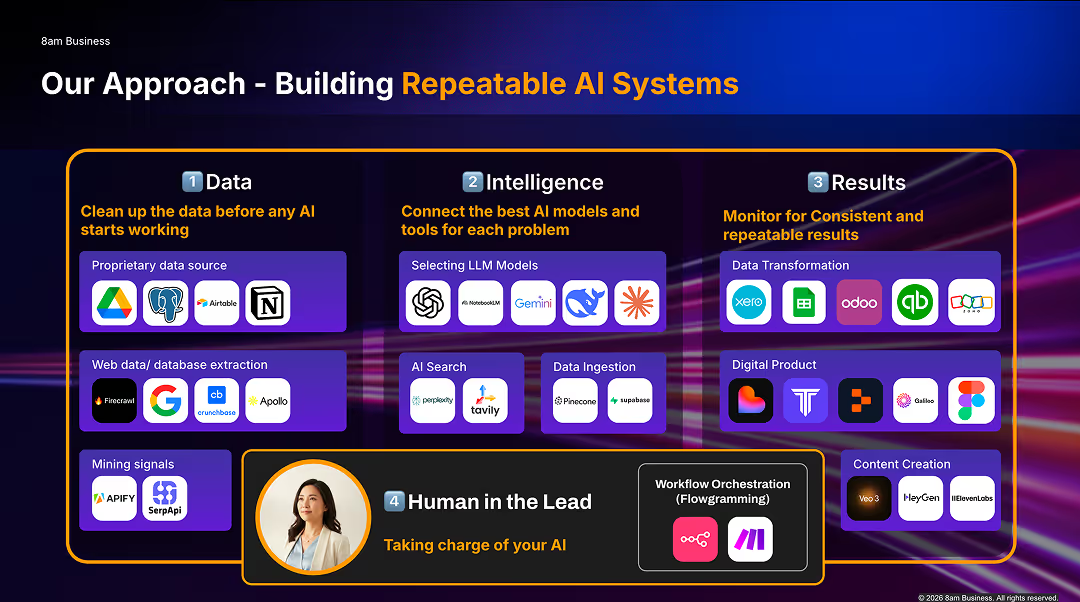
The AI-Confident Framework is built on four pillars that reflect how we lead business leaders in deploying AI Systems:
Pillar 1: Data Is the Foundation
AI systems do not start with prompts. They start with clean, structured, proprietary data.
Most AI failures can be traced back to poor data hygiene: unstructured files, conflicting sources, outdated records, or unclear ownership. Before intelligence is applied, data must be extracted, cleaned, and contextualised.
When data is treated as a first-class asset, AI stops guessing and starts executing.
Clean data removes noise.
Noise is what causes hallucinations.
Pillar 2: Intelligence Is an Engine, Not a Model
There is no single “best” AI model.
Modern AI systems are multi-model by design, selecting the right intelligence for the right task. One model may excel at reasoning and logic - e.g. Claude. Another may be better at creative rendering - e.g. Gemini. A third may specialise in real-time search or validation - e.g. Perplexity.
This is where orchestration becomes critical. Models are not prompted directly by humans; they are triggered by systems, fed structured inputs, and evaluated through predefined logic.
In practice, this means businesses stop “using AI tools” and start orchestrating AI agents.
Pillar 3: Results Must Be Consistent at Scale
In business, consistency beats brilliance.
An AI system must produce outputs that are reliable on the 1st run and the 100th run. Whether generating reports, transforming financial data, producing marketing assets, or responding to customers, quality should not depend on who wrote the prompt that day.
This is why AI systems are embedded into workflows — not layered on top of them. Inputs are standardised. Outputs are formatted. Exceptions are flagged. Metrics are tracked.
When AI produces repeatable results, it delivers value.
Pillar 4: Human-Led Orchestration Is Non-Negotiable
This is the “confident” part of AI-Confident.
The future of AI for business is not fully autonomous. It is human-directed.
In high-performing AI systems, humans design the logic, define the guardrails, and approve edge cases. AI executes within those boundaries. This approach dramatically increases trust, compliance, and adoption.
Rather than replacing people, AI elevates them - from operators to orchestrators of intelligent agent force.
Confidence comes from command and control of your AI, not blind automation.
Stop Prompting. Start Building AI Systems.
Chatbots are a starting point. Agents are a stepping stone. AI systems are the destination.
The AI-Confident Framework is about moving from experimentation to execution — from novelty to infrastructure. When data is clean, intelligence is orchestrated, outputs are consistent, and humans stay in control, AI stops being a tool and starts becoming a strategic asset.
AI-Confidence doesn’t come from better prompts, it comes from better systems.